Ships of the future: Energy efficiency with aerodynamic or solar catamarans
The aerodynamic catamaran for fast, efficient transport in La Rochelle
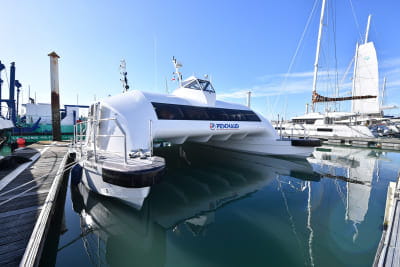
Their hulls, aerodynamic as much as hydrodynamic, required two years of research and development on their own.
© XAVIER LEOTY / AFP
They look like manta rays, glide along the water’s surface at speeds of up to 110 km/h and consume less fuel than a conventional boat: the innovative catamarans built in La Rochelle by Advanced aerodynamic vessels (A2V) could revolutionize passenger shipping. The “dynamic lift” catamarans developed by the La Rochelle-based SME (12 employees) are reminiscent of a stingray from the front, and a prehistoric crustacean from the back. “It was thought of as half an airplane engine, or an airplane wing curved towards the water,” is quick to correct A2V co-founder Lionel Huetz.
These hulls, aerodynamic as much as hydrodynamic, took two years of research and development alone, but the result is impressive: with conventional engines and a subtle weight distribution to prevent it from flipping over, the catamaran reaches speeds of 40 to 60 knots depending on the model (from 75 to 110 km/h), while remaining among the most economical. “Compared with a boat with the same engine, ours goes twice as fast and consumes half as much on average,” sums up Mr. Huetz.
In passenger transport, it is estimated today that to go 100 miles from the coast at an average speed of 40 knots, you need a 36-meter boat, weighing 120 tons and able to take 40 people on board, i.e. a consumption per passenger of 30 liters of fuel for 100 km. “For 60 passengers, we offer a 24-meter boat that consumes 10 liters of fuel per passenger for 100 km, and at 60 knots”, assures A2V’s Managing Director, who is also a naval architecture engineer and holds a doctorate in naval hydrodynamics. All in all, this represents a saving of several million liters of fuel oil every year, a strong argument for the environment – encouraged, incidentally, by grants from the French Environment and Energy Management Agency (Ademe)- but also for the profitability of an investment of the order of two million euros.
The performance of A2V’s vessels is linked to the catamaran’s structure, which has been the subject of numerous patents. The open bow lets a lot of air in under the platform, compressing the air and creating the famous “lift” that relieves the boat of some of its mass. Lighter, the catamaran tends to float above the water, less subject to ocean and wave resistance. Result: the boat can go faster while consuming less.
Even better, “the boat needs to carry less fuel than the others, which reduces its weight and in fact enables it to go faster more easily, as lift starts around 25 knots. It’s a virtuous circle,” emphasizes Lionel Huetz. All in all, it took A2V just four years to design and produce these one-of-a-kind boats.
A 25-seater “crew boat” is due to join Gabon and its owner, a French company specializing in offshore and onshore oilfield support logistics, in a few weeks’ time. And a 12-seater speedboat will shortly be delivered to a shipowner operating on Lake Geneva for a luxury hotel in Evian (Haute-Savoie), looking for an alternative to helicopters to transport its wealthy guests from the nearby airport or golf course.
Depending on the type of navigation for which they will be intended (river, lake or open sea in all weathers), A2V’s catamarans will feature different hulls, to which the famous naval architect Marc Lombard (with whom Lionel Huetz worked) lent his assistance.
olg-ban/cam – AFP
The solar-powered catamaran for a new form of yachting at Beaulieu sur Mer
The port of Beaulieu-Sur-Mer is home to another type of catamaran: the solar catamaran. Thanks to its hydrodynamic efficiency the SeaZen has sailed for over a year without needing to recharge from the grid. What’s more, the aerodynamic profile of its solar roof, designed like an airplane wing, offers little wind resistance, which is a safety feature in the event of unforeseen weather conditions.
Passengers discover a new form of silent, odorless sailing. The charm of sailing and the simplicity of motorboating. Generally speaking, tourists visiting Nice or Monaco enjoy the activity of cruising on the sea, while residents prefer to rent a boat without a license with self-service access.
Passengers discover a new form of sailing, silent and odorless.